How to Dry a Phone Speaker Fast: The Methods That Actually Save Time
Need to dry a wet phone speaker quickly? Here is a speed-ranked comparison of every real method sound, airflow, silica gel, and why rice is the slowest option plus a video guide.
When “Just Wait It Out” Is Not Good Enough
Some water damage advice assumes you have all the time in the world. Bury it in rice for two days. Leave it in a drawer for 48 hours. Just be patient. That is fine advice if your phone is a backup device you rarely touch but for most people, a phone is how work calls come in, how directions get followed, how the day actually runs. When the speaker goes muffled or silent after a splash, “just wait” is not really an answer; it is a stall tactic.
The good news is that drying a phone speaker does not actually have to take days. Some methods are genuinely fast measured in seconds to a couple of hours while others that get repeated as folk wisdom are, frankly, some of the slowest and least effective options available. This guide ranks the real methods by actual speed, explains why some work faster than others, and walks through exactly how to use the quickest ones safely. There is a video demonstration included as well.
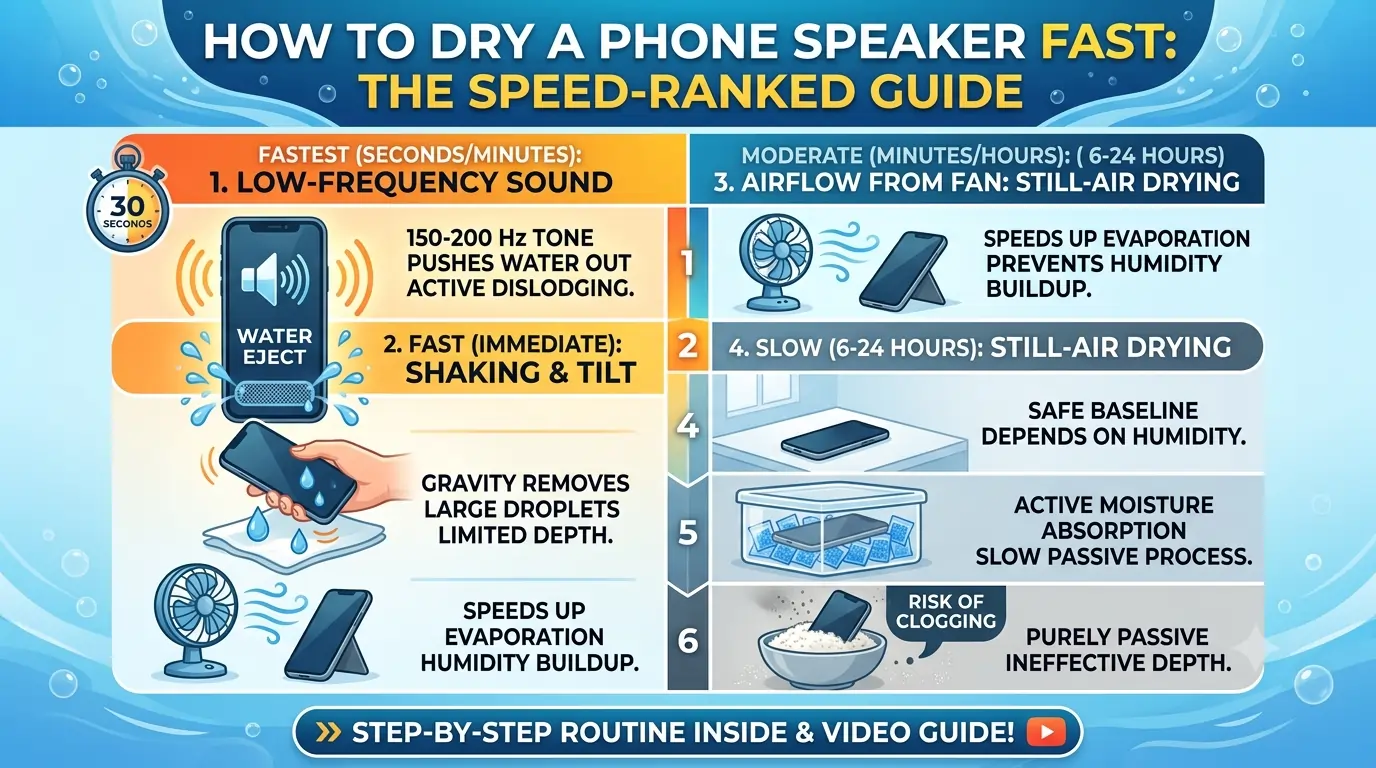
Not all drying methods are created equal — some take seconds, others take days for the same result.
First: Understand What You Are Actually Drying
Before ranking methods, it helps to know what is actually happening physically. Water gets trapped in two main ways after a splash or dunk:
- Standing droplets sitting in the tiny openings of the speaker mesh, physically blocking sound from passing through clearly.
- A thin film or residual moisture clinging to the speaker diaphragm itself, dampening its ability to vibrate properly and produce clear sound.
The fastest methods target both of these directly and actively. The slowest methods rely purely on passive evaporation, which works eventually but does nothing to speed up the physical removal of water sitting in those small spaces.
Ranked: The Fastest to Slowest Ways to Dry a Phone Speaker
1. Low-Frequency Sound (Fastest — Seconds to Minutes)
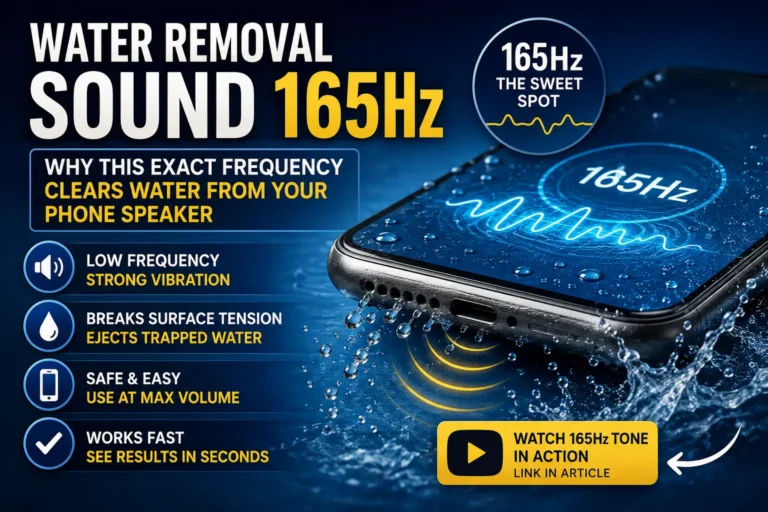
This is, by a wide margin, the quickest active method available. A calibrated low-frequency tone — commonly cited around 150–200 Hz, with 165 Hz frequently mentioned as a specific benchmark — makes the speaker diaphragm vibrate with a large enough range of motion to physically push trapped water droplets out through the mesh. Because it is an active, targeted method rather than passive waiting, results are often visible within 30–60 seconds per cycle, with most people seeing meaningful improvement after two or three cycles.
Why it is fastest: it directly and repeatedly disturbs the exact spot where water is trapped, rather than waiting for ambient conditions to slowly pull moisture away on their own.
2. Gentle Shaking and Positioning (Fast — Immediate, but Limited)
Gently tilting the phone with the speaker facing downward, combined with a light shake, can dislodge larger surface droplets almost instantly. This is a good first-aid step to combine with sound-based ejection, but on its own it only helps with water sitting right at the surface of the grille — it will not reach moisture that has settled deeper around the diaphragm.
Why it is fast but incomplete: gravity works quickly on loose water, but it cannot do much about droplets held in place by surface tension deeper in the mesh.
3. Airflow From a Fan (Moderate — Roughly 30 Minutes to a Few Hours)
Placing the phone in front of a small fan, speaker facing down, accelerates evaporation meaningfully compared to still air. Moving air continuously carries away the humid layer that naturally builds up right at the surface of the wet area, which speeds up the rate at which remaining moisture evaporates.
Why it is moderate: it is still a passive method — it just removes the “stagnant air” bottleneck that slows down still-air drying.
4. Still-Air Drying in a Ventilated Room (Slow — Roughly 6–24 Hours)
Simply leaving the phone speaker-down in a dry, open room without any airflow assistance works, but it depends entirely on ambient humidity and temperature. This is the method most official phone manufacturer guidance points to as a safe baseline, precisely because it involves no additional risk — but “safe” and “fast” are not the same thing here.
Why it is slow: without moving air, the space immediately around the wet area stays humid longer, which slows the rate of evaporation considerably compared to a fan-assisted setup.
5. Silica Gel Packets (Slow — Roughly 12–24 Hours)
Silica gel is a genuine desiccant, meaning it actively pulls moisture out of the surrounding air rather than just waiting for it to evaporate on its own. Sealed in a container with a phone, it does meaningfully speed up overall drying compared to leaving the phone out in open air alone — but it still works on a timescale of many hours rather than minutes, since it is addressing ambient humidity rather than directly disturbing trapped droplets in the speaker mesh.
Why it is slow despite being “better than rice”: it is still a passive absorption process, just a more efficient one than rice.
6. Uncooked Rice (Slowest — 24–48+ Hours, and Often Ineffective)
Despite being the most commonly repeated advice, rice is genuinely the weakest option on this list. It absorbs moisture slowly, does not reach water trapped deep in the speaker cavity at all, and frequently leaves behind fine starch dust that can further clog the very mesh you are trying to clear. Apple’s own support guidance explicitly advises against it for exactly these reasons.
Why it is slowest: it is a purely passive method that does not actively address trapped water in the speaker mesh, and it introduces a real risk of adding new debris.
Rice remains the most commonly repeated advice, but it is genuinely the slowest and least targeted method on this list.
Step-by-Step: The Fastest Realistic Drying Routine
Combining the quickest methods in the right order gives you the best realistic shot at clear sound in minutes rather than days.
Step 1: Power Down Immediately
If the phone is still wet, turn it off right away to reduce the risk of a short circuit while moisture is present.
Step 2: Pat the Exterior Dry
Use a soft, absorbent cloth on the outside of the phone, including the speaker grille, charging port, and buttons. Avoid vigorous shaking that could push water deeper inside.
Step 3: Gently Tilt and Shake
With the phone off, tilt it so the speaker faces downward and give it a few gentle shakes to help surface-level droplets fall away.
Step 4: Remove the Case
Take off any case completely — it can trap moisture against the grille and dampen the effect of sound-based cleaning.
Step 5: Run a Low-Frequency Sound Cycle
Once the phone is safely powered back on and mostly dry on the outside, open a browser-based or app-based water ejection tool. Set the volume to maximum, tilt the speaker downward, and run the tone for 30–60 seconds.
Step 6: Check for Visible Droplets
Look at the surface beneath the speaker — a paper towel or soft cloth works well — for any small droplets that were pushed out during the cycle.
Step 7: Repeat Two or Three Times
Space cycles a few minutes apart and test with real audio (a voice memo or a quick call) between each one to track improvement.
Step 8: Add Airflow While You Wait Between Cycles
If any dampness remains, prop the phone speaker-down in front of a small fan for 20–30 minutes between sound cycles. This speeds up evaporation of whatever moisture the sound cycles have not already ejected.
Watch the Fast-Drying Process in Action
Here is a demonstration showing the sound-based ejection method in practice, which is the fastest active step in this entire process:
📺 Video: How to Get Water Out of Your Phone Speaker (100% Works!)
https://www.youtube.com/watch?v=QhDYZdODB28
What Slows Drying Down (Even When You Are Trying to Be Fast)
A few common habits actually work against speed, even when the intention is to dry things out quickly:
- Using heat. A hair dryer or placing the phone in direct sunlight seems like it should speed things up, but heat risks warping the speaker diaphragm, melting internal seals, and — counterintuitively — can push moisture deeper into the device as it turns to vapor and re-condenses elsewhere.
- Charging a wet phone. Beyond the safety risk, a wet charging port can also interfere with accurate testing of whether the speaker itself has actually dried.
- Testing too frequently. Repeatedly powering the phone on and off to check progress does not speed up drying and adds unnecessary electrical stress while moisture may still be present.
- Sealing the phone in an airtight container without a desiccant. Without silica gel or another active moisture absorber, a sealed container just traps humid air right against the phone, slowing evaporation rather than helping it.
Adjusting for the Type of Liquid Involved
Not all liquids dry at the same rate or with the same follow-up needs:
- Plain water (rain, sink splash): typically the fastest to fully resolve, since there is no residue left behind once the water evaporates or gets ejected.
- Sweat: similar to plain water in terms of drying speed, though it can leave a very light salt residue if left for very long periods without cleaning.
- Pool or salt water: dries at a similar physical rate, but chlorine and dissolved minerals can leave behind residue that sound-based ejection alone will not fully clear — a gentle brush cleaning afterward often helps.
- Sugary drinks (soda, juice): the sugar content leaves sticky residue that can continue affecting sound even after all visible moisture is gone, making a light cleaning step more important than with plain water.
When Fast Is Not Fast Enough: Signs You Need More Time or Help
Even with the quickest methods, some situations call for patience or professional attention rather than continued rapid attempts:
- No improvement at all after several sound cycles and a few hours of combined drying methods suggests something beyond simple trapped water may be involved.
- Crackling that comes and goes unpredictably, rather than steadily improving, can indicate early corrosion rather than straightforward moisture.
- Extended submersion of more than a minute or two raises the chances that water reached areas a speaker-focused drying routine cannot influence.
In these cases, continuing to chase a “fast fix” can do more harm than good — it is better to give the phone a longer rest period or have it inspected professionally.
Testing with real audio between drying attempts is the best way to judge genuine progress.
Frequently Asked Questions
What is genuinely the fastest way to dry a phone speaker?
A low-frequency sound cycle, typically in the 150–200 Hz range, is the fastest active method, often showing improvement within 30–60 seconds per cycle.
Is rice really as slow as people say?
Yes. Rice absorbs moisture passively and slowly, generally requiring 24–48 hours, and it does not address water trapped deep in the speaker mesh at all — plus it can add starch dust to the problem.
Can I speed up drying by combining multiple methods?
Yes, and it is actually the most effective overall approach — using sound-based ejection first, then airflow from a fan during any rest periods, tends to produce the fastest realistic full recovery.
Does a hair dryer actually speed things up?
It might seem like it should, but heat carries real risks — warping speaker components, melting seals, and potentially pushing moisture deeper into the device rather than out.
How quickly should I expect normal sound to return?
For a light splash, often within minutes to an hour using sound-based ejection. For heavier exposure, a combination of sound cycles and airflow over a few hours is more realistic.
Is it safe to keep running sound cycles back-to-back to speed things up further?
It is better to space cycles a few minutes apart and test in between, rather than running them continuously — this gives you a clearer read on actual progress and avoids unnecessary prolonged max-volume playback.
Final Thoughts
Drying a phone speaker fast does not mean cutting corners it means choosing the methods that are actually built to work quickly instead of defaulting to the slowest, most commonly repeated advice. A low-frequency sound cycle, combined with gentle positioning and a bit of airflow between rounds, can take care of the vast majority of everyday splashes in minutes rather than days. Rice, in particular, deserves to be retired from the conversation entirely it is slow, often ineffective, and can introduce new problems of its own.
Skip the waiting game where you can, use the methods that actually target trapped water directly, and save the “just be patient” advice for the rare cases where it is genuinely all that is left to try.
Found a drying method that worked especially fast for you? Share it in the comments, and pass this guide along to anyone who is about to bury their phone in rice out of habit.